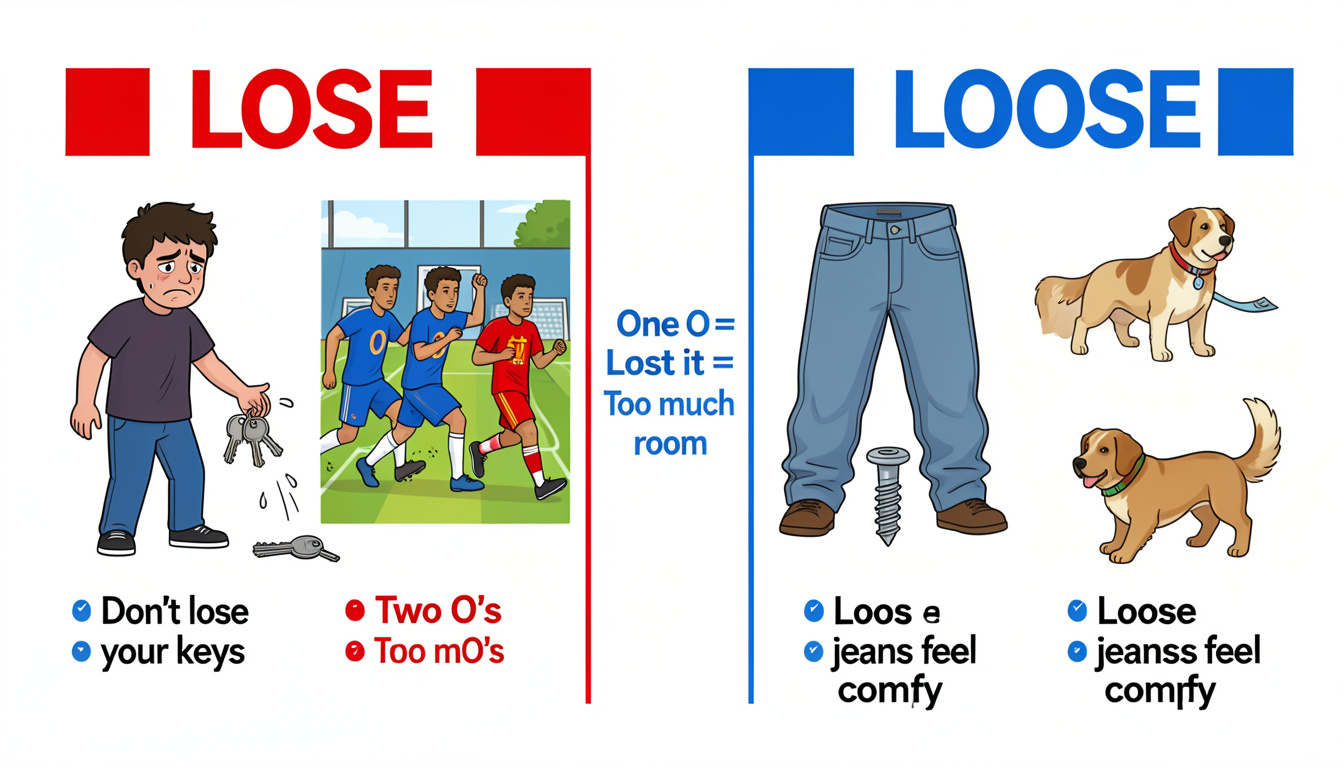
If you’ve ever typed a sentence and paused wondering whether to write “lose” or “loose,” you’re not alone. These two words are among the most commonly mixed up in the English language. Understanding the lose and loose meaning clearly can save you from embarrassing typos in emails, blog posts, or professional documents. Let’s break it down once and for all.
Let’s break down the meaning, usage, and tricks to remember these words correctly.
What Does “Lose” Mean?
Lose is a verb. It is only ever a verb. That’s the first important thing to know. You can’t use “lose” as an adjective or a noun — it always describes an action or a state of being.
The word “lose” has three primary meanings:
- To fail to win: “We might lose the championship game if we don’t practice harder.”
- To misplace or be unable to find something: “I always lose my keys when I’m in a hurry.”
- To be deprived of something: “She didn’t want to lose her job over one mistake.”
Pronounced as /luːz/ (rhymes with “snooze”), “lose” carries a soft “z” sound at the end. Think of it this way — “lose” has one “o,” and when you lose something, you have one less of it. That’s a helpful memory trick.
The past tense of “lose” is lost. For example:
- “We lost the match yesterday.”
- “He lost his wallet on the train.”
The present participle is losing:
- “She is losing patience with the slow internet.”
- “Our team is losing by two points.”
What Does “Loose” Mean?
Loose, on the other hand, is primarily an adjective. It describes the state of something — usually meaning not tight, not firm, or not securely attached.
Here are the most common meanings of “loose”:
- Not tight or not firmly attached: “The screw is loose — the shelf might fall.”
- Not fitting closely (especially clothing): “She prefers loose dresses in the summer heat.”
- Not strictly controlled or exact: “The new office has a loose dress code.”
- Free from restraint or confinement: “Be careful — there’s a loose dog in the neighborhood.”
Pronounced as /luːs/ (rhymes with “goose” or “juice”), “loose” has a clean “s” sound at the end — crisp and sharp. The double “o” in “loose” gives it a roomier feel, which actually mirrors its meaning: something that has extra space, something not tightly bound.
Interestingly, “loose” can also function as a verb in rare cases, meaning to release or set free. For example: “The archer loosed an arrow into the sky.” However, this usage is uncommon in modern everyday English.
Side-by-Side: The Key Differences
Here’s a quick breakdown of the two words:
Common Mistakes and How They Happen
The confusion between “lose” and “loose” is so widespread that it appears constantly in emails, social media posts, blog comments, and even professional writing. Here are some classic error examples and their corrections:
Wrong: “I always loose my phone charger.”
Right: “I always lose my phone charger.”
Wrong: “We might lose the match if the defense stays this lose.”
Right: “We might lose the match if the defense stays this loose.”
Wrong: “The team played very loose and ended up loosing the game.”
Right: “The team played very loose and ended up losing the game.”
Notice that “losing” — the present participle of “lose” — only has one “o.” Many people mistakenly write “loosing,” which is almost never correct in standard English writing.
Easy Memory Tricks
Memorizing rules is much easier when you have a mental hook to hang them on. Here are two quick tricks:
- “Lose” has one “o” — and when you lose something, you have one less. If you misplace your keys, you go from having them to not having them. One “o,” one loss.
- “Loose” rhymes with “goose” — and a goose that gets loose is running free. The double “o” creates extra space, just like something loose has extra room or is not tightly held.
Another way to remember: “Lose” is always a verb. Ask yourself — am I describing an action or a state? If it’s an action (failing, misplacing, being deprived), use “lose.” If it’s a description of how something feels or fits (not tight, free, untethered), use “loose.”
Using Them Together Correctly
The best way to cement your understanding is to see both words used correctly in the same context:
- “If your shoelaces are loose, you might trip and lose the race.”
- “A loose strategy will only help you lose clients.”
- “Don’t lose focus just because the schedule is loose.”
Reading sentences like these trains your brain to associate the right word with the right meaning automatically.
The Loser vs. Looser Mix-Up
One more related confusion worth addressing: loser and looser.
- Loser (one “o”) is a noun. It describes a person who loses a game or competition. Example: “Nobody wants to be a loser.”
- Looser (two “o”s) is the comparative form of “loose.” It means “more loose.” Example: “This knot is looser than the previous one.”
These two words are also frequently swapped in casual writing, so keep an eye out.
Final Word
The English language is full of tricky word pairs, but “lose” and “loose” are entirely manageable once you know what to look for. Remember: lose is a verb about failure or misplacement, and loose is an adjective about freedom and lack of tightness. Different spelling, different pronunciation, different purpose — simple as that. The next time you sit down to write, pause for one second before choosing between these two, and you’ll get it right every time.